Bidirectional charging enables electric vehicles not only to draw power but also to feed it back into the grid. The Bi-CCS project is developing vehicle-to-grid applications and smart charging infrastructure for this purpose.
Project Lead Dr. Mark Kuprat from the Brandenburg University of Technology discusses current challenges, standards such as ISO 15118-20, and the “V2X+” approach.
In our projects, we are exploring how electric vehicles can not only be charged in the future but also actively become part of the energy system themselves. The overarching term for this is Vehicle-to-X, or V2X in short. The idea behind it is to use vehicle batteries as flexible storage, meaning they not only absorb electricity but also supply it back when needed.
In Cottbus and Senftenberg, we are testing various use cases for this together with partners from research, industry, and the energy sector. Particularly exciting is the combination of charging infrastructure, smart energy management, and real vehicle fleets. We view electric vehicles as virtual swarm storage. Many vehicles together result in enormous storage capacities that could potentially be used for grid stability or the integration of renewable energies.
A particular focus is on feeding power back into the public grid. This is currently still complex from a regulatory standpoint and only possible in certain scenarios. That is why we are working on some pilot applications with special permits from grid operators. At the same time, we are also investigating how bidirectional charging can be implemented in private households or in company parking lots. These projects provide us with important practical experience, both technically and economically.
The technology is currently developing significantly faster than the regulatory framework. Technically, much of it already works surprisingly well, but economically and regulatory, there are still numerous unresolved issues.
A central issue is feeding electricity from vehicle batteries into the public grid—that means vehicle-to-grid. So far, this has only been possible to a limited extent in Germany. At the same time, there are still many pricing components, such as grid fees, levies, and surcharges, that complicate business models.
While initial hurdles, such as the so-called burden of double grid fees, have been addressed, that alone is not yet enough to make bidirectional charging economically attractive.
In addition, there are many players involved along the entire value chain, each of whom wants to establish their own business models. For example, anyone who wants to use dynamic electricity rates needs a corresponding electricity provider. For feeding electricity into the grid, a direct marketer is also required. On top of that, there are smart meter gateways, metering point operators, and grid operators. Each of these players claims a portion of the revenue or charges fees.
This quickly makes the economics complex. In theory, attractive arbitrage opportunities can be realized through low electricity prices on the exchange. In practice, however, the many additional cost components often reduce the actual economic benefit. This is precisely why there is currently intense discussion about which regulatory components could be eliminated or reduced in the future.
We use “V2X+” to describe the next stage of development in bidirectional charging. Classic Vehicle-to-Home means that a household uses electricity from the vehicle to optimize its own consumption. This is already an exciting use case, especially in combination with photovoltaic systems.
The “Plus” here primarily stands for the safety aspect provided by island capability. This means that during a blackout, an electric vehicle functions as a self-sufficient energy source: The home is automatically disconnected from the public grid and continues to be powered by the vehicle’s battery—for several days in an emergency.
This is a highly relevant topic, especially internationally. In regions with frequent power outages, such as those caused by natural disasters, this opens up entirely new fields of application. While Germany has very stable power grids by international standards, the situation is different in parts of the U.S. or Japan, for example. There, such systems can offer real added value.
Furthermore, the technology enables targeted grid support. Here, the vehicle performs active system services, such as frequency control or the management of bottlenecks in the distribution grid. This approach goes far beyond mere electricity trading and is a crucial building block for integrating fluctuating renewable energies into our energy system in a stable manner over the long term. Particularly with regard to grid-forming system services, such as instantaneous reserve, this is referred to as V2G+.
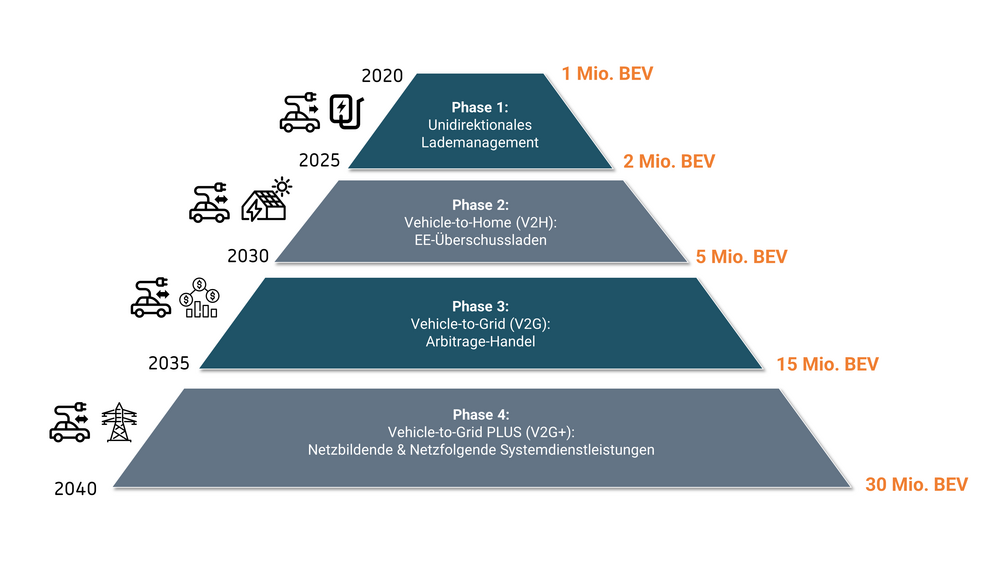
There are still some technical limitations that are rarely discussed. Bidirectional charging, for example, causes charging and conversion losses with an efficiency of approximately 80 percent. As soon as functions in the car are used, internal consumption of about 300–500 watts occurs. This also applies when the car is stationary, as the car requires energy to enable bidirectional charging.
Added to this is the issue of interoperability between manufacturers. Many systems today still operate within the ecosystems of individual manufacturers—that is, vehicles and charging stations from proprietary manufacturers. With ISO 15118-20, a mandatory standard for new systems will take effect in 2027; however, this does not mean that everything will be converted immediately and across the board. So there will still be a transition phase in which different solutions coexist.
I am convinced that bidirectional charging will become a reality in the long term. The fundamental direction is clear from both a technical and an energy-economic perspective. Electric vehicles already come equipped with large battery storage, and it is precisely this flexibility that will be needed in the energy system of the future.
However, we must not underestimate the challenges. Regulatory adjustments, standardized communication, interoperable systems, and economically viable business models are needed. Furthermore, users must develop trust in the technology. Many people still expect their vehicle to be fully charged and available at all times. In the short term, therefore, we will primarily see specialized applications, such as in fleets, businesses, or pilot regions. There, the framework conditions can be managed much more effectively than in the private mass market.
However, with increasing standardization and declining hardware costs, the technology will gradually become more widespread. I therefore believe that bidirectional charging will be a standard component of modern energy systems in a few years, even if the path to that point will still take some time.