Today The smarter E Europe 2026 opened its doors to the fully booked halls at Messe München: Until June 25, around 2,800 international exhibitors are presenting their solutions, applications and business models for a 24/7 renewable energy supply. More than 100,000 visitors and 2,800 exhibitors from all over the world are expected to attend over the next three days. The opening took place against the backdrop of historic global upheaval: Geopolitical crises and volatile raw material markets are threatening the stability of entire economies. Dependency on fossil fuels is jeopardizing industrial competitiveness and taking a huge toll on national budgets. We learned this the hard way during the fossil energy crisis in 2022/2023, which in Germany alone required a government relief package of 187 billion euros.
With this in mind, transforming the energy system has long been about more than protecting the environment; it is a modernization program vital for industry, security and the economy. The renewable energies industry is poised to solve this double crisis of fossil fuel dependency and climate change. The industry is a reliable partner, ready to secure long-term prosperity and competitiveness through technological sovereignty. The organizers and a new scientific accompanying study by Fraunhofer Institute for Solar Energy Systems leave no doubt: An uninterrupted energy supply from renewable sources ensures reliable power around the clock, protects the economy and consumers from cost risks and drives economic growth. The message of this exhibition opening is clear: The new energy world is ready and it has proven its financial viability; the industry is leading the way with confidence.
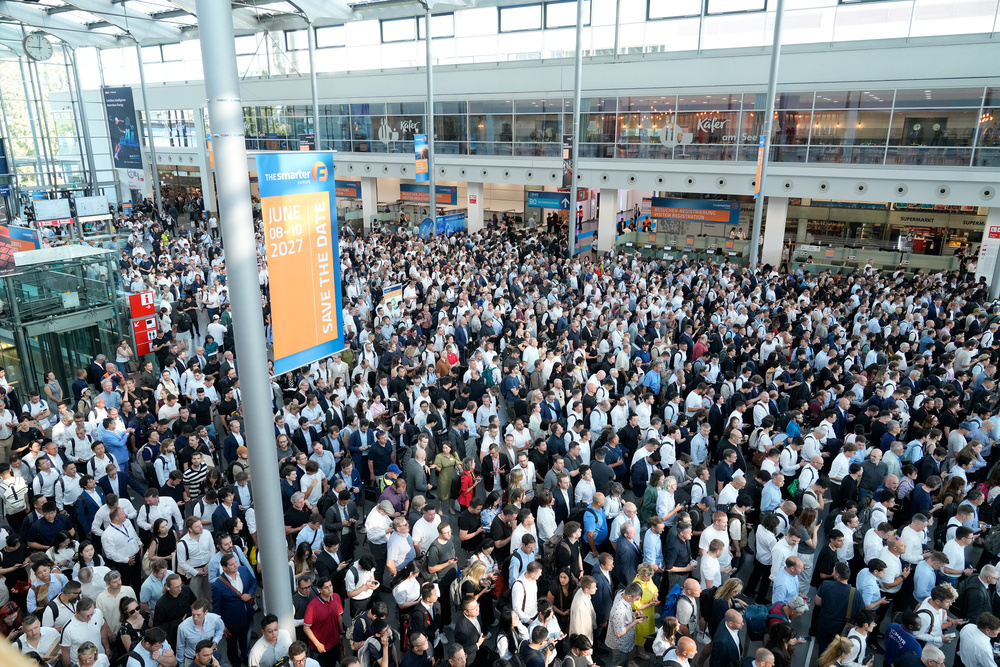
From solar and storage to e-mobility and digital grid infrastructure – the industry is united and has a clear message. Markus Elsässer, CEO of Solar Promotion GmbH, discusses these developments: “Wind and solar energy have long formed the secure foundation of our energy system. At The smarter E Europe, we prove categorically that renewable energy sources can supply us securely 24 hours a day, seven days a week. This way we can create a resilient system that minimizes geopolitical risks and sustainably strengthens national security.”
The study Cost-Optimal Transformation of the German Energy System by 2045, commissioned by the organizers, provides the scientific evidence for taking this path and delivers a model for modern industrial nations such as Germany. Dr. Charlotte Senkpiel, Senior Scientist at Fraunhofer ISE rebuts doubts about stability: “Our data proves that even an energy system supplied purely by renewable sources is reliable. Sun and wind perfectly complement each other. An intelligent combination of grids, decentralized battery storage systems, controllable power plants operated with climate-neutral gases and flexible demand fully offsets fluctuations caused by the weather.”
In addition, the transition increases geopolitical resilience. Using local sources reduces the demand for fossil fuel imports, in Germany alone by around 80 percent. This protects economies against extreme financial risks such as the European energy crisis of 2022/2023, which resulted in billions of euros worth of aid packages. Millions of decentralized solar plants, wind parks and batteries also reduce the risk of targeted attacks on central large-scale power plants and stabilize critical infrastructure.
The transformation is the most rational decision for the economy. Dr. Christoph Kost, Head of Department Energy System Analysis at Fraunhofer ISE, explains the economic benefits: “The costs of avoiding CO2 are around 210 euros per metric ton, which is far less than the costs of climate change, which the Federal Environmental Agency estimates at 880 euros per metric ton.” The additional costs of the energy transformation – without taking replacement investment into account – amount to an average of 54 billion euros per year over the next 25 years, or a cumulated extra 1.3 trillion euros compared with the current system. That being said, the system will eventually become cost neutral. Volatile raw material prices and future costs of climate change are effectively absorbed by millions of decentralized players and a falling dependency on imports. The result will be a stable, cost-effective system.
The transformation is also reviving the international job market. One in three job vacancies worldwide now originates from the green economy, significantly exceeding the number of jobs lost in traditional industries. In order to fully utilize this economic benefit, the further expansion of renewable energies must not falter. The entire energy infrastructure needs to progress quickly without political or regulatory interruption. This is the only way to supply the electricity needed as a consequence of the ongoing electrification, transportation and industry. The power demand is expected to rise by almost fourfold by 2045.
The smarter E Europe will present the results of scientists’ models. The absolute highlight of this year’s event is therefore the special exhibit Renewables 24/7, which demonstrates the real, intelligent coordination of renewable generation, storage, flexible energy infrastructure and digital management. Five key attributes will be on display for the expert audience: reliability, cost efficiency, promotion of prosperity, resilience and climate neutrality. A broad alliance of leading industry associations are supporting the special exhibit, including the German Renewable Energy Federation (BEE), the German Association of Energy Market Innovators (bne), the German Solar Association (BSW-Solar), the German Solar Energy Society (DGS), the German Hydrogen Association (DWV), the Biogas Trade Association, VDMA (German Engineering Federation) Photovoltaics Equipment and VDMA Power Systems. It is also internationally backed by E-Mobility Europe, Energy Storage Europe, Smart Energy Europe (smartEn) and SolarPower Europe. Leading technology partners contributing to the project include CATL, Energy3000, Fenecon, FoxESS, GE Vernova, Maxsolar, Octopus Energy and Siemens AG.
Jens Mohrmann, Managing Director of Freiburg Wirtschaft Touristik und Messe, emphasizes its relevance to trade visitors: With our special exhibit we are turning complex scientific knowledge into a hands-on experience. Around 2,800 exhibitors are using our platform to show that the clean energy future is already working. We combine global innovative power and provide the space for global decision makers to connect.
From June 23–25 the four exhibitions – Intersolar Europe, ees Europe, Power2Drive Europe and EM-Power Europe – as well as the accompanying conferences and exhibition forums are displaying the entire spectrum of the new energy system. The industry is ready to deliver, backed by a strong international network. Closing the remaining emissions gaps worldwide depends on how quickly policymakers and society change regulatory framework conditions and speed up implementation.