2025 was a year of acceleration for electromobility and, at the same time, a year in which decisive political and technological hurdles were overcome. While the industry presented significant progress with innovative solutions for megawatt charging and bidirectional charging, politics and regulation in Germany and Europe provided the necessary regulatory framework in several areas for the first time.
This dynamic was clearly reflected at Power2Drive Europe: the market ramp-up is in full swing, and the focus is increasingly on integration, efficiency and smart sector coupling.
Hardly any other topic attracted as much attention in 2025 as bidirectional charging. Technologically, both AC and DC-based systems are available, and numerous pilot projects are already delivering convincing results.
In France and the Netherlands in particular, pilot projects are demonstrating how integration can look in everyday life. Take, for example, the Utrecht Energized project or the pilot project by Renault and The Mobility House, which allows electric car drivers to charge their vehicles for free if they make their batteries available for grid-serving purposes. Marcus Fendt, Managing Director and CSO of The Mobility House, recently said in The smarter E podcast that bidirectional charging could allow drivers to travel 1,000 kilometres for €10.
The decisive incentive in Germany was recently provided by lawmakers: with the amendment of the Energy Industry Act (EnWG), clear legal foundations were created for the first time to firmly integrate bidirectional applications into the energy system. This removes key obstacles that had previously slowed down investments and business models. Among other things, the new regulations concern the role of storage facilities, the classification of bidirectional vehicles and the requirements for grid services. At the same time, the AFIR regulation strengthens the European framework: it requires transparent prices, simple ad hoc payments and uniform technical standards. In addition, international practical examples show tangible results: In a pilot project by Smart Energy Lab in Portugal, intelligent V2G strategies enable savings of up to €20 per month and location, despite high hardware costs and unresolved software issues, while also improving local grid management through optimised use of renewable energies.
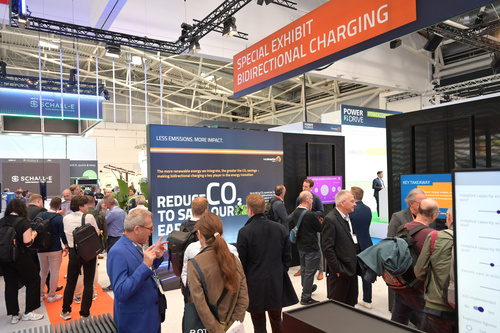
Another highlight was the special exhibition on bidirectional charging at the past Power2Drive Europe. Around 2,000 media reports about it worldwide impressively underlined the growing relevance of this topic.
Megawatt charging: power for heavy-duty transport
There were further important developments in the field of megawatt charging, which is considered a key technology for the electrification of heavy-duty transport. It is essential for heavy commercial vehicles, which rely on short charging times due to their high daily ranges and tight schedules. With a full load, driving distances of 500 to 600 kilometres per battery charge are already comfortably possible, making these vehicles a serious and cheaper alternative to diesel, also due to their lower maintenance costs.
At the same time, the price structure for charging has come into sharper focus. The significant differences between individual providers illustrate how important transparency is for users and how competitive pressure on operators is increasing. This is precisely where the 2030 Charging Infrastructure Master Plan, which was adopted by the German Federal Government in 2025, comes in. It bundles measures to simplify approvals, optimise grid integration and strengthen consumer-friendly conditions. This brings the national strategy closer in line with the European AFIR guidelines.
At the same time, the pressure for transformation is increasing on European vehicle manufacturers. Battery production, recycling, securing raw materials and the ability to seamlessly integrate vehicles into the energy system are becoming decisive factors for their future competitiveness.
The year 2025 laid the foundations for the coming decade. Bidirectional charging is no longer a research topic but is becoming an integral part of the energy and mobility industry. Power2Drive Europe 2025 – with its special exhibition and accompanying white paper – impressively demonstrated how close technological innovations are now to the market. The amendment to the Energy Industry Act (EnWG), the 2030 Charging Infrastructure Master Plan and the AFIR Regulation also sent strong political signals: electric mobility is no longer just a transport issue but is becoming a flexible building block in a renewable energy system.
The outlook is clear: 2026 will be the year of implementation. Bidirectional vehicles will find their first applications in everyday life, megawatt charging will become more widely available, and regulation will increasingly pave the way for fully connected, emission-free mobility.
Whitepaper "Bidirectional Charging - the Future of Smart Energy Supply"
Interview with Marcus Fendt (The Mobility House)
Podcast with Marcus Fendt (The Mobility House)