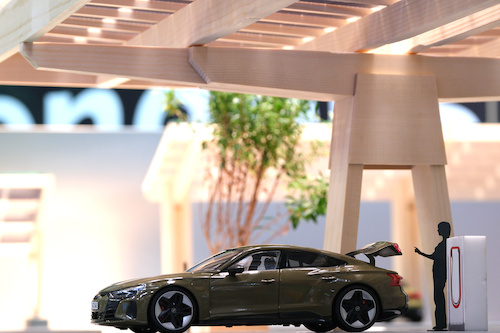
The German federal government has presented a new subsidy program for electric cars, which will come into effect on January 1, 2026, and will be funded with around €3 billion until 2029. It is aimed at private buyers and leasing customers and is intended to support up to 800,000 new vehicles.
Depending on income, family size, and vehicle type, the subsidies range from €1,500 to a maximum of €6,000 per vehicle. The subsidy also applies to certain plug-in hybrids and vehicles with range extenders, as long as they meet strict CO₂ and electric range criteria. Applications are expected to be possible via an online portal from May 2026 and can be submitted retroactively to January 1, 2026.
Unlike previous subsidy programs, the new subsidy scheme focuses on social scaling. Households with lower taxable income and families with children receive higher subsidies. The income limit is generally set at €80,000 per year. The income limit increases by €5,000 per child for up to two children. For two or more children, the income limit rises to €90,000. Purely battery-powered electric vehicles receive a basic subsidy of €3,000, while plug-in hybrids start at €1,500. For lower incomes and families with children, the subsidies add up to €6,000.
Representatives of the automotive industry describe the subsidy package as an important stimulus for the domestic market. Open participation without restrictions on origin, i.e., including vehicles from China, is intended to drive competition and broaden the range of products, without erecting protectionist barriers. In this way, Germany wants to strengthen its role as an attractive sales market and utilize domestic production capacities.
However, it is also clear that further federal funding for charging infrastructure is not planned in the foreseeable future, meaning that the reluctance to expand is over and investments in smart charging infrastructure are once again on the rise. Manufacturers and providers of charging infrastructure point to structural bottlenecks, however. Daniel Gwercher, Managing Director Germany at Zaptec, says: “For this signal to have its full effect, charging infrastructure must be taken into account – especially in apartment buildings, company parking lots, and residential complexes, where demand is greatest. Intelligent charging systems already enable scalable expansion without costly grid expansion. Now it is important to create the right framework conditions here as well.”
Supporters see the reintroduction of subsidies as a way to stabilize demand and production of electric vehicles. After the purchase subsidies expired at the end of 2023, demand declined temporarily before rising again in 2025.
Parallel to the introduction of social grading, the framework conditions for vehicle imports in the EU have also changed. Since January 2026, Chinese manufacturers have been able to agree on minimum prices for the export of BEVs instead of high punitive tariffs. As a result, brands such as BYD are increasingly focusing on plug-in hybrids in Europe, which benefit from lower import duties.
Despite the positive momentum, the reform is not without controversy. Environmental and consumer protectionists criticize the fact that partially electric drives are also being promoted and are calling for a stronger focus on real CO₂ savings. They also criticize the fact that the subsidy only covers new cars and so far excludes used vehicles, even though it is precisely this price threshold that has a greater influence on many buyers.
Industry observers emphasize that financial incentives alone are not enough. The expansion of the charging infrastructure, lower electricity prices, and reliable framework conditions are at last equally crucial for lasting market change. Without these complementary measures, the effects of the purchase premium could remain limited.
At the state level, for example, Bavaria continues to offer subsidies for charging infrastructure. The new subsidy guideline “Charging Infrastructure for Electric Vehicles in Bavaria,” valid since January 1, 2026, supports the construction and modernization of public and non-public charging points. The specific funding conditions are determined through regular calls for proposals and include grants of up to 60 percent of eligible costs with fixed maximum amounts per charging point, depending on charging capacity and area of application. In Austria, the expansion of private charging infrastructure is being promoted as part of the “E-Mobility for Private Individuals 2025” program, with subsidies of up to €600 for wall boxes or smart charging cables in single-family and two-family homes and up to €1,800 in multi-family homes with load management, including eligible installation costs in each case.
With the new subsidy program, Germany is sending an economic signal to strengthen demand for battery-electric vehicles. The social scaling is primarily intended to ease the burden on households with medium and low incomes and make the market more accessible. At the same time, ecological objectives and structural decisions, for example regarding infrastructure and emissions-related subsidies, remain key challenges for the further development of the German automotive market.