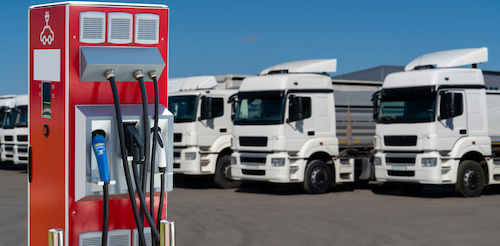
The electrification of European road freight transport is gaining momentum. Several recent market analyses and studies – including publications by the Fraunhofer Institute and Bain & Company’s “European Truck Outlook” – paint a clear picture: Battery-electric trucks are outperforming diesel vehicles in terms of operating costs, and megawatt charging is increasingly becoming a central focus of logistics planning.
The days when electric powertrains in the logistics sector were considered merely a vision of the future are over. According to analyses by Bain & Company and ICCT, battery-electric trucks have achieved total cost of ownership (TCO) parity with diesel vehicles for most applications. Bain’s survey of more than 500 fleet operators in Europe shows that electric trucks are rated extremely positively, especially when it comes to key purchasing criteria. Furthermore, according to Bain, traditional brand loyalty is eroding significantly; about one-third are considering switching brands or no longer show a strong attachment to a specific OEM. At the same time, openness toward new players is growing. Chinese manufacturers in particular – who are especially strong in the electric truck segment – are being considered.
For a long time, infrastructure expansion in European long-haul transport was based on rough estimates. The VESUVIO model used by Fraunhofer ISI and the ICCT breaks with this imprecision and, for the first time, provides a high-resolution, spatiotemporal analysis of charging demand for battery-electric trucks in the European Union – comprising its 27 member states as well as the United Kingdom, Switzerland, and Norway.
The results paint a scenario of considerable scale: According to the Fraunhofer ISI and ICCT study, under favorable conditions, the annual electricity demand for electric trucks will rise to around 100 terawatt-hours by 2035 and double to about 200 terawatt-hours by 2045. However, what is decisive is not the sheer total volume, but its uneven distribution. The calculations show that in many countries, just one percent of all potential locations account for one-quarter to one-third of the total charging power. The top ten percent even account for between 60 and 90 percent of national demand. The ramp-up is thus measurably concentrated along specific corridors and hubs.
Contrary to the common belief that public spaces must be comprehensively covered with high-power chargers, the studies clearly differentiate between operating models. According to the research, traditional depot charging serves as an indispensable foundation in all European markets examined and typically accounts for between 70 and 80 percent of total charging demand.
Consequently, companies meet the majority of their energy needs overnight or during downtime on their own premises. Nevertheless, the data underscores that public charging along the route remains of strategic importance for long-distance transport: According to the study’s authors, it can account for up to half of total demand, particularly in smaller transit countries.
The researchers’ core recommendation stems directly from this two-part structure: Blanket infrastructure targets are ineffective. Instead, investments must be channeled and precisely targeted at those corridors, highway interchanges, and industrial centers that have been identified as absolute hotspots by Fraunhofer ISI and the ICCT.
Otherwise, these high-traffic hubs face the risk of massive local peak loads, which in larger countries with high freight traffic volumes can reach values between 20 and 50 megawatts per location – an energy demand equivalent to that of an entire small town. To relieve the strain on the grid at these locations, stationary storage and smart flexibility measures, in combination with traditional grid expansion, play a key role. Bidirectional charging, in particular, can unlock enormous potential here.
The analyses underscore that grid development and the expansion of megawatt-scale charging must be strictly synchronized with actual traffic flows. Those who act proactively here will transform this infrastructure bottleneck into a predictable competitive advantage for the European logistics industry and drive forward the decarbonization of freight transport.
Furthermore, the Bain & Company analysis reveals that the transformation is fundamentally reshaping not only the infrastructure but the entire truck market. As brand loyalty erodes and operators become increasingly open to new providers, European OEMs are under significant pressure to act.