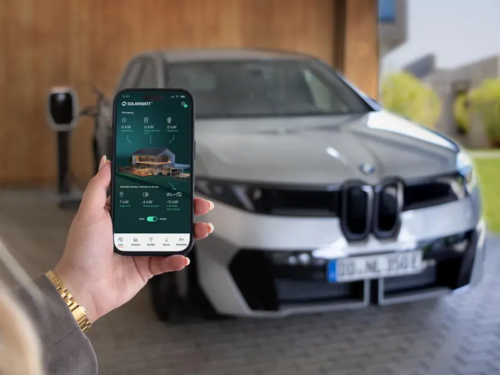
Bidirectional charging is moving beyond the niche of pilot projects and heading toward market ramp-up. This year’s Power2Drive Europe focused on market-ready solutions that flexibly integrate electric vehicles into the home energy system (Vehicle-to-Home, V2H) or directly into the energy market (Vehicle-to-Grid, V2G). Two leading industry players presented specific product packages and partnerships for the German market at the exhibition.
The collaboration between beegy and KOSTAL demonstrated that this technology will continue to shape the agenda in the long term. With an AC BiDi wallbox announced for 2027 and the corresponding HEMS control system based on open standards, the companies are already preparing for the next generation of bidirectional charging.
BMW and photovoltaic specialist SOLARWATT, which have been collaborating since 2013, are further expanding their partnership. The goal is the seamless integration of the vehicle as an additional energy storage system (V2H) for the home.
The joint offering is aimed at owners of the new BMW iX3 and i3 models (the so-called “Neue Klasse”) and connects the vehicle to the home via the bidirectional BMW Wallbox Professional. The SOLARWATT Manager home energy management system (HEMS), which can be controlled via an app, manages the energy flows. The vehicle is managed via the BMW app.
During the presentation at Power2Drive Europe, company representatives highlighted the financial benefits of the system: The V2H integration alone can save 372 euros, and an additional 339 euros can be saved when a dynamic electricity rate plan is incorporated.
The market launch for the joint V2H offering in Germany, Austria, and the Netherlands is planned for late 2026. BMW, together with E.ON, already unveiled a V2G offering in 2025.
Volkswagen subsidiary Elli is taking another step toward grid integration. Together with the Group brands Volkswagen, Volkswagen Commercial Vehicles, and CUPRA, the company has unveiled an integrated product package for Vehicle-to-Grid (V2G) charging in Germany. What makes it special is that, for the first time, the vehicle enables customers to actively participate in the energy market.
To minimize technical and regulatory hurdles for end users, Elli offers a one-stop solution:
Compatible models include those running ID. Software 3.5 or later (with a 77-kWh battery) as well as all models with the new ID. Software 6. For the technical implementation of flexibility marketing and the aggregation of vehicles into a virtual power plant, Elli partially relies on the FlexEngine platform provided by the service provider The Mobility House Energy.
The new product launches at Power2Drive Europe 2026 illustrate that the automotive and energy industries increasingly view electric cars as an integral part of the energy system. While the solution from BMW and SOLARWATT is primarily aimed at optimizing the private home environment and self-sufficiency (V2H), the Volkswagen Group, through Elli, is addressing grid-friendly power feed-in and the commercial use of vehicle batteries in the energy market (V2G). Both approaches promise to mobilize unused storage capacity and thereby facilitate the integration of renewable energy.