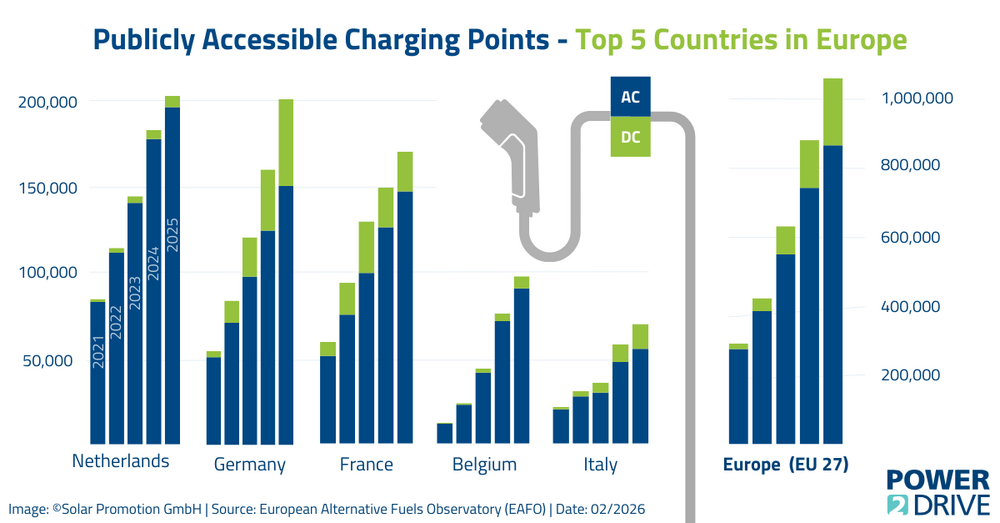
The war in the Middle East is causing the price of diesel and petrol to spike. In fact, the prices have not been this high for a long time. This is making the switch to electromobility and the expansion of charging infrastructure within the European Union (EU) even more urgent. 2025 saw considerable growth rates, as almost 1.9 million new fully electric vehicles and delivery trucks were registered. This is an increase of over 30 percent compared to the previous year and brings the market share of e-vehicles to 17,4 percent. The growth rate for trucks was even higher, reaching over 70 percent. More than 26,000 new e-trucks were registered in 2025. The expansion of the charging infrastructure followed suit. Across the EU, there are now more than one million public charging stations and over 1,512 heavy duty vehicle (HDV) charging points. Visitors to Power2Drive Europe from June 23–25 in Munich will be able to learn about current regulations, the latest technological developments for charging infrastructure, fleet electrification and funding opportunities. All important industry players will be there. Power2Drive Europe is the international exhibition for charging infrastructure and e-mobility and part of The smarter E Europe, the continent’s largest alliance of exhibitions for the energy industry. Around 2,800 exhibitors and more than 100,000 visitors from all corners of the globe are expected to attend the four concurrent exhibitions this year.
In the EU, there is a clear trend away from internal combustion engines. The number of people opting for a petrol or diesel passenger car is shrinking. In 2025, the share of combustion engines among new registrations dropped to 35.5 percent, almost 10 percentage points less than in 2024. The future belongs to electromobility. And that is why the expansion of the charging infrastructure needs to continue. The EU’s goal is to have more than 3.5 million charging points by 2030. “Charging infrastructure is the backbone of electromobility because it provides consumers with electricity and energy security. It is growing at an unparalleled pace across the EU member states. To keep up the momentum, we need investments and a collaboration between public and private partners. Backed by innovation, this will pave the way towards an interconnected, accessible and future-proof network,” says Chris Heron, Secretary General of E-Mobility Europe, an industry association.
The differences between EU member states are striking. Some countries are driving the expansion while others have hit the brakes. The Netherlands, Germany, France, Belgium and Italy are leading. The race for second place has already been decided, because last year, Germany deftly overtook France and secured the runner-up position, almost catching up with the Netherlands, who had been leading for many years. Germany’s public charging points are being used for around 2.3 hours per day on average, bringing their capacity utilization to just under ten percent. Usage varies depending on the time of day, the location and sometimes even the season. Germany and France both promote fast charging stations while in some Eastern, Central and South European countries, finding a charging station remains a challenge. Estonia, Latvia, Lithuania, Hungary, Bulgaria, Romania, the Czech Republic, Slovakia, Slovenia, Croatia, Malta, Greece, Luxembourg and Ireland have a lack of infrastructure. Bottlenecks in the power grid and prolonged approval processes present obstacles to the expansion. In Europe, the approval can take up to two years, compared with less than six months in China. Facilitation and acceleration are needed for the future. At the end of 2025, the European Commission presented an action plan to reduce bureaucracy, boost digitalization and promote one-stop shops. In the future, market maturity will be the deciding factor for approval rather than the date of submission.
Some countries – Germany among them – are looking to boost the sales of electric vehicles and the expansion of charging infrastructure through national incentive programs. Germany is planning to install fast charging points for battery electric trucks in highway lay-bys with 1.6 billion euros of federal government funding. The subsidies have been approved by the European Commission.
Harmonized charging standards
To harmonize charging across the EU, new guidelines have been in place since January 8, 2026, specifying the technical design of publicly accessible charging points. All new or updated public alternating current (AC) charging points must meet the EN ISO 15118-2:2016 standard and require a so-called PLC modem to allow the vehicle and the charging point to share key information. Drivers who want to charge away from home will need a roaming app or a charging card. The next step, from January 1, 2027, affects new publicly accessible AC charging points, direct current (DC) charging points and private mode 3 charging points. All of them will have to support the revised EN ISO 15118-20:2022 standard, which covers additional functions such as bidirectional charging (vehicle-to-grid). This means that the car battery can not just be charged with electricity, it can also feed electricity back. The ability for extended plug & charge allows the charging process to start automatically as soon as the cable is connected – no need for an app or a card.
Forum and conference look at the future
On all exhibition days, the Power2Drive Forum offers the possibility to connect with the industry’s key players: manufacturers, distributors, start-up companies and professional users. Leading experts will gather one day ahead of the exhibition at the Power2Drive Europe Conference (June 22–23). The event will focus on the latest developments in e-mobility, political framework conditions, new business models, bidirectional charging and best practices. Discussions will center on how the increased demand for charging capabilities and grid capacity can be reconciled, and how Europe can secure and expand its position in the global race for the electric vehicle market.